


The most useful output from an AI pilot is a decision a business owner can defend. A fluent demonstration can create enthusiasm, but the investment decision needs evidence about the whole task: what staff received, what they corrected, what it cost and whether the result was safe to use. Agreeing that evidence before the pilot starts makes the eventual review much more useful.
Choose a task with a clear finish line
Start with a workflow someone can describe without naming a product. Drafting a service summary from approved job notes is a workable candidate. Improving productivity across the business is too broad to evaluate. Identify who supplies the input, who checks the output and what happens next. A task with accessible examples and a willing process owner gives the team a clearer starting point.
The DTA distinguishes technical feasibility from a pilot that validates value and readiness with real users in a controlled setting. Its AI transition guidance is written for government agencies, but the distinction is useful for business planning: proving that a model can generate a summary does not establish that the summary fits daily work.
An AI readiness assessment can help connect a proposed use case with available data, process ownership and realistic constraints. Decide the pilot's boundary before choosing the most impressive feature set.
Measure the current work as well as the AI
Choose the comparison method before collecting results. Keep the input complexity and expected output consistent, and note any extra assistance pilot users receive. If staff learn better prompting during the trial, record that training effort. The owner needs to understand what would be required to repeat the performance with the next group.
Record a baseline using representative tasks from the current process. Include routine cases and awkward ones, such as incomplete notes or conflicting source material. Capture active staff effort separately from waiting time. Record the checks people perform and the rework that returns later. Otherwise, a faster first draft can hide a slower approval process.
Useful output: can a reviewer use the result for its intended purpose, with the required information present?
Review effort: how much checking, correction and escalation does each completed task require?
Failure handling: does the workflow recognise missing information and give staff a safe next action?
Operating cost: include licences, integration, training, support and human review alongside model usage.
The DTA's success criteria guidance recommends complementary metrics and warns that a single metric can create false confidence. Apply that principle by pairing speed with quality and review effort. Define the consequences of an error before choosing an acceptable threshold.
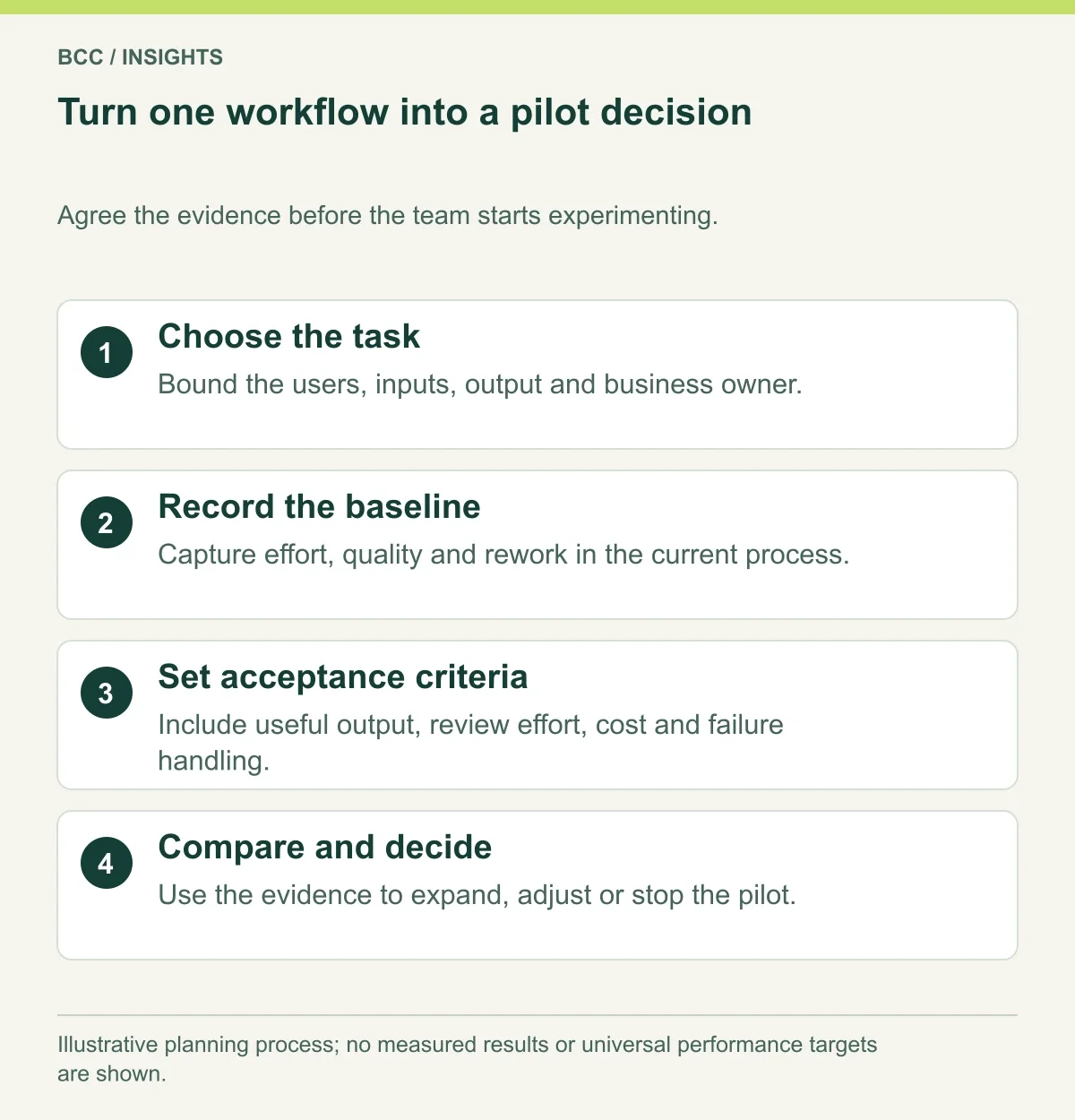
Turn one workflow into a pilot decision. Illustrative planning process; no measured results or universal performance targets are shown.
Work through a bounded example
Consider a fictional equipment servicing business testing draft customer summaries from technician notes. The pilot covers completed maintenance visits only; safety advice and quotations remain outside its scope. A supervisor prepares approved reference summaries, then checks each proposed draft against the original notes. The team records omitted work, unsupported statements and correction time, as well as drafting effort.
Suppose a note lacks the part number needed for the summary. The agreed behaviour is to flag the missing detail for the supervisor. A polished guess fails the criterion. At the review, the owner can decide whether that workflow is useful with its current supervision, needs better source notes, or should stop. This is an illustrative design example, with no assumed saving or measured outcome.
Make the decision gate explicit
Name the person who can approve expansion and set the review date. Keep a record of test cases, changes to instructions and unresolved issues so the comparison remains understandable. If the team changes the workflow halfway through, explain which results remain comparable. Include user feedback and the effort needed to maintain the system after the pilot team leaves.
Use AI consulting to challenge the business case and AI process automation to examine the surrounding handoffs. Bring BCC one candidate workflow, representative inputs and your current approval steps. We can help define a pilot scorecard and a decision gate that fit the work before you expand the investment.
Sources
DTA: AI transition stages and dimensions — Part of Guidance for AI proof of concept to scale, last updated 2026-03-11; government guidance used as a business planning reference.
DTA: Statement 12 — Define success criteria — Parent AI technical standard last updated 2025-08-22; requirements address Australian Government agencies.
DTA: Appendix 2 — AI evaluation — Parent guide last updated 2026-03-11; evaluation options do not promise a return on investment.
Editorial date: 6 August 2026, assigned for this retrospective Insights series. Prepared and sources checked on 30 October 2026. Updated 30 October 2026.