



A successful backup report tells you something about the backup job. A recovery rehearsal answers a broader business question: can the people responsible bring a critical service back into use with acceptable downtime and data loss? Testing that question creates evidence about dependencies, access and procedures that a job status alone cannot supply.
Start with the service owner
Choose a service the business understands, such as order dispatch or payroll preparation. Identify its owner and ask what must work for staff to resume the task. Include the application, required data, configuration and supporting access. Define the exercise boundary so the team knows whether it is testing one component or the entire service.
Agree the recovery objectives before the exercise. APRA's CPG 230 guidance describes recovery time objective as the maximum allowed recovery time for information assets supporting a service, and recovery point objective as tolerable data loss expressed in time. These are useful planning terms; APRA's prudential guidance addresses its regulated financial sector and does not impose these requirements on every business.
Have the owner explain the operational consequences behind the targets. How would staff reconstruct missing transactions? What manual work is possible during disruption? A backup and disaster recovery review can then examine whether the proposed recovery arrangement supports those needs.
Test more than an individual file
ASD's Essential Eight assessment guide calls for regular, at least annual disaster recovery exercises and explains that routine user-file recovery is insufficient for that control. Its focus is restoring a significant system component, including related data, applications and settings. Use that distinction to define a meaningful exercise for your chosen service.
ASD launched the Essentials series on 15 October 2026 and is maintaining both frameworks during transition. Confirm the guidance and obligations relevant to your organisation when planning an assessment. The exercise still needs a clear purpose, authorised scope and evidence of what happened.
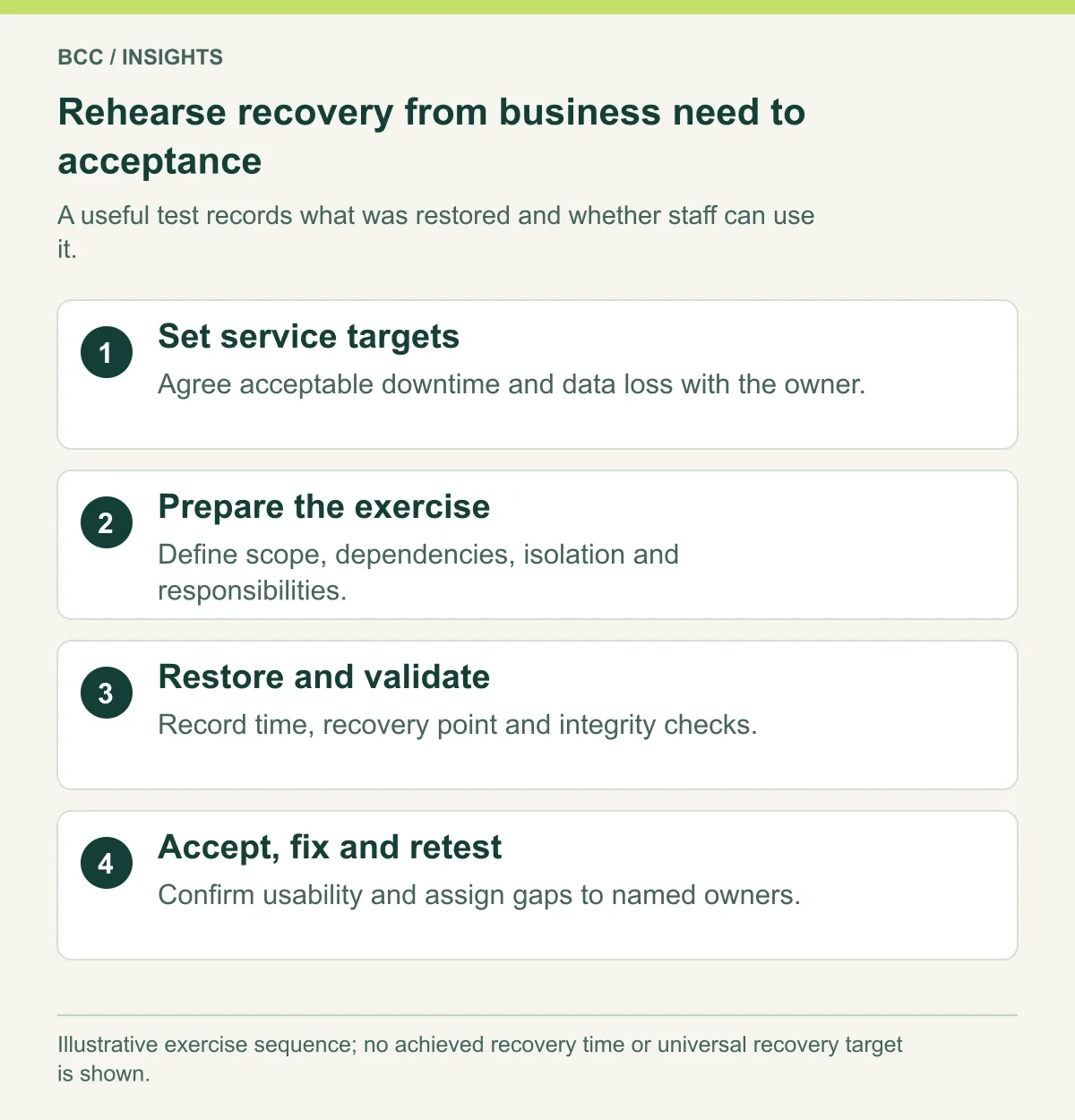
Rehearse recovery from business need to acceptance. Illustrative exercise sequence; no achieved recovery time or universal recovery target is shown.
Prepare a controlled rehearsal
Scope and isolation: define what will be restored and how the exercise avoids unintended changes to live systems.
People and access: nominate the recovery lead, technical operators and business validator; confirm required access is available.
Dependencies: identify the configuration, identity, connectivity and other components needed to use the restored service.
Measurements: specify when the recovery clock starts and stops, and how the restored data point will be checked.
Acceptance: agree the integrity checks and business task that demonstrate usable recovery within the exercise scope.
Keep an observer's record of steps, timings, errors and decisions. If a procedure needs undocumented knowledge, record that gap even when an experienced operator can continue. Check the recovered content and application behaviour before declaring the exercise complete. Restoring files and validating that staff can carry out the intended task are separate checks.
A fictional distributor rehearses dispatch
Consider a fictional distributor testing its order dispatch service in an isolated environment. The service owner nominates a set of known orders for validation. The team restores the application, database and configuration from compatible recovery points, then checks that the nominated orders and their statuses match the expected record.
A warehouse supervisor follows the normal dispatch steps using the restored environment. If a required label template is absent, the exercise report records that dependency and assigns a fix. The team compares the observed recovery time and recoverable data point with its agreed targets. This is a proposed exercise, with no assumed pass, recovery speed or customer result.
Close the loop after the test
Write a short review stating what was tested, what was excluded, the objectives achieved or missed and the evidence retained. Give each gap an owner and a retest condition. Connect the procedure with incident response planning so staff understand how recovery decisions fit an actual disruption.
Bring BCC one critical service, its current backup arrangement and the last restoration record. Our cyber security consulting can help define a scoped rehearsal, practical acceptance checks and an action plan for the gaps it reveals.
Sources
ASD: Essential Eight assessment process guide — Published 2022-11-24, reviewed 2024-10-02; backup assessment guidance calls for significant system restoration exercises.
APRA: CPG 230 Operational Risk Management — June 2024, Table 4 (Types of tolerance levels for disruptions); definitions are explanatory, not requirements for every business.
ASD: Essentials framework launch — Published and reviewed 2026-10-15; ASD maintains Essential Eight and Essentials during the transition.
Editorial date: 29 October 2026, assigned for this retrospective Insights series. Prepared and sources checked on 30 October 2026. Updated 30 October 2026.