



A lower cloud invoice is easy to celebrate. It is less informative if the application also processed fewer orders or jobs. To decide whether operating efficiency improved, connect an agreed slice of spending to a useful business outcome. This does not replace the total budget. It adds the context needed to distinguish reduced waste from reduced activity or a decline in service.
Choose a unit that the business recognises
The FinOps Foundation's unit economics capability connects technology cost with units of business value. For a smaller organisation, a useful starting measure might be cost per completed report, fulfilled transaction or active customer. The right unit follows the workload. Counting every API request can be misleading if retries or background polling increase while useful completions remain flat.
Define the numerator and denominator together. Decide whether cost includes only production infrastructure or also shared databases, network transfer, backup and support. Define what counts as a successful completion and how cancelled or repeated work is treated. Record these choices so a later review compares the same thing. A convenient number with shifting boundaries is poor evidence for an investment decision.
Read the invoice and the unit cost together
Here is a deliberately hypothetical example, using Australian dollars rather than any provider's prices. Period A allocates AUD1,200 of cloud cost to 6,000 completed jobs: AUD0.20 per job. Period B allocates AUD1,000 to 4,000 completed jobs: AUD0.25 per job. Total cost falls by AUD200, but the unit cost rises. The calculation alone does not explain why.
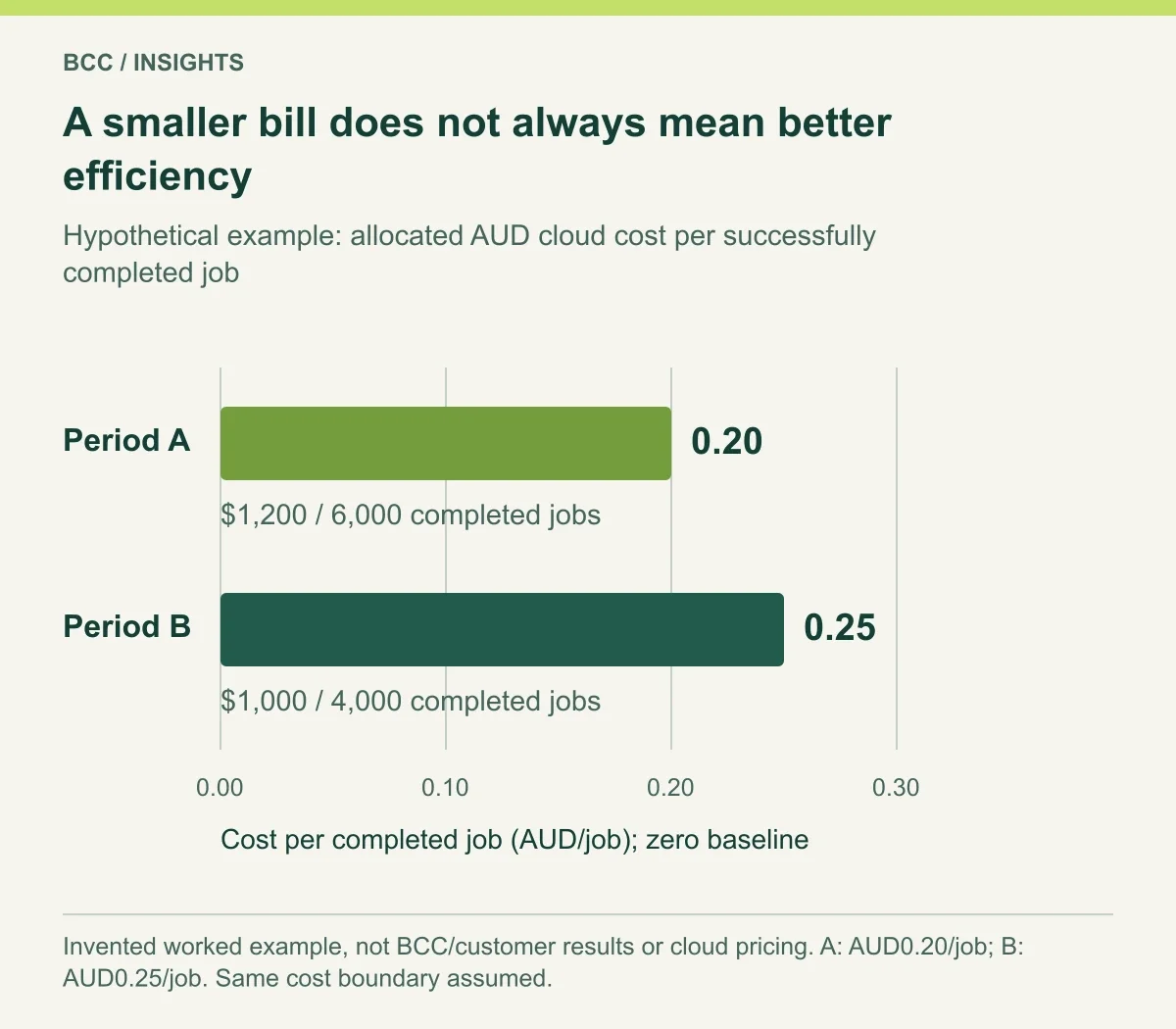
A smaller bill does not always mean better efficiency. Invented worked example, not BCC/customer results or cloud pricing. A: AUD0.20/job; B: AUD0.25/job. Same cost boundary assumed.
Perhaps fixed capacity is now spread across fewer jobs. Perhaps the jobs are more complex, a one-off migration cost is included, or failure rates have increased. Investigate those differences before describing the change as improved or worsening efficiency. Compare similar periods and workload mixes, and keep an exception note when a business event makes the comparison imperfect.
Make costs attributable before making commitments
Assign an owner to each material workload and use an agreed allocation method for shared services. Resource labels can help, but they need consistent use and billing support. Start with the largest unexplained costs rather than requiring perfect allocation of every small item. Keep a separate list of resources that may be unused, and validate dependencies before retiring them.
Ownership: someone can explain the workload and approve changes.
Allocation: production, test and shared costs have documented boundaries.
Demand: completed business units are counted consistently.
Quality: latency, failures and recovery requirements stay visible beside cost.
Action: each proposed change has a verification step and an accountable owner.
A budget alert needs a response plan
AWS explains that budget information is updated periodically, so notifications should not be treated as instantaneous spending controls. Decide who receives an alert, what they inspect and which actions they can approve. Automatic shutdown may be inappropriate for a production service whose interruption costs more than the usage it prevents.
Review utilisation before changing capacity or purchasing longer commitments. An average can conceal important peaks, and removing redundancy can alter the recovery model. Trial a bounded change, observe a representative operating period and check both successful throughput and user experience. Retain the option to reverse the change where practical, and document any reliability trade-off that the business knowingly accepts.
Keep the source billing period, completion count and allocation calculation with each comparison. If credits or one-off charges materially affect a period, show their treatment explicitly. This lets another reviewer reproduce the unit cost and separates an accounting change from a change in the workload's operating behaviour.
Use the review to make one defensible decision
Bring a workload cost breakdown and a useful completion measure to BCC's cloud infrastructure management discussion. Cloud consulting can help define the comparison before broader AWS or Azure architecture choices. Start with one explainable unit cost and one verified improvement; avoid turning an unclear invoice into an unsupported savings promise.
Sources
FinOps Foundation: Unit Economics capability — Undated maintained guidance; publication date not stated. Accessed during retrospective batch preparation.
AWS Cost Management: Best practices for AWS Budgets — Undated maintained guidance; publication date not stated. Accessed during retrospective batch preparation.
Editorial date: 29 September 2026, assigned for this retrospective Insights series. Prepared and sources checked on 30 October 2026. Updated 30 October 2026.