


Moving a workload into the cloud changes where it runs. It does not automatically establish that the business can use it, operate it or recover it. One of the most important planning questions comes just after the switch: if staff have entered new transactions and a serious problem appears, what happens to those transactions? That question should be answered before the migration window begins.
Build acceptance around business tasks
A successful server start or database copy is a technical checkpoint. Business acceptance needs representative tasks: authenticate using the expected identity, create a valid record, exchange information with a connected system and produce an agreed output. Assign a person who understands each result. Record the baseline beforehand so the new environment can be compared with a known working process.
Discovery should also capture less visible dependencies: scheduled jobs, external allowlists, certificates, outbound mail, file paths, licensing and administrative access. AWS's pre-cutover guidance recommends planning dependency checks, testing, downtime and rollback. Use those planning categories to challenge assumptions, then adapt the runbook to the actual workload and provider.
Name the decision-maker and the latest decision point
Specify what would stop the migration, who has authority to decide and how much time recovery needs. A cutover window can be consumed by repeated troubleshooting until the safe return option has disappeared. Work backwards from the agreed business deadline to identify the point at which the team must either meet acceptance criteria or execute the prepared recovery route.
Before cutover: confirm access, backup usability, dependencies and named business testers.
During synchronisation: define whether writes are paused and how consistency is checked.
Before acceptance: execute functional and integration tests and record their results.
After acceptance: monitor the business workflow and assign operational ownership.
If acceptance fails: follow the agreed rollback or forward-recovery decision, including treatment of data.
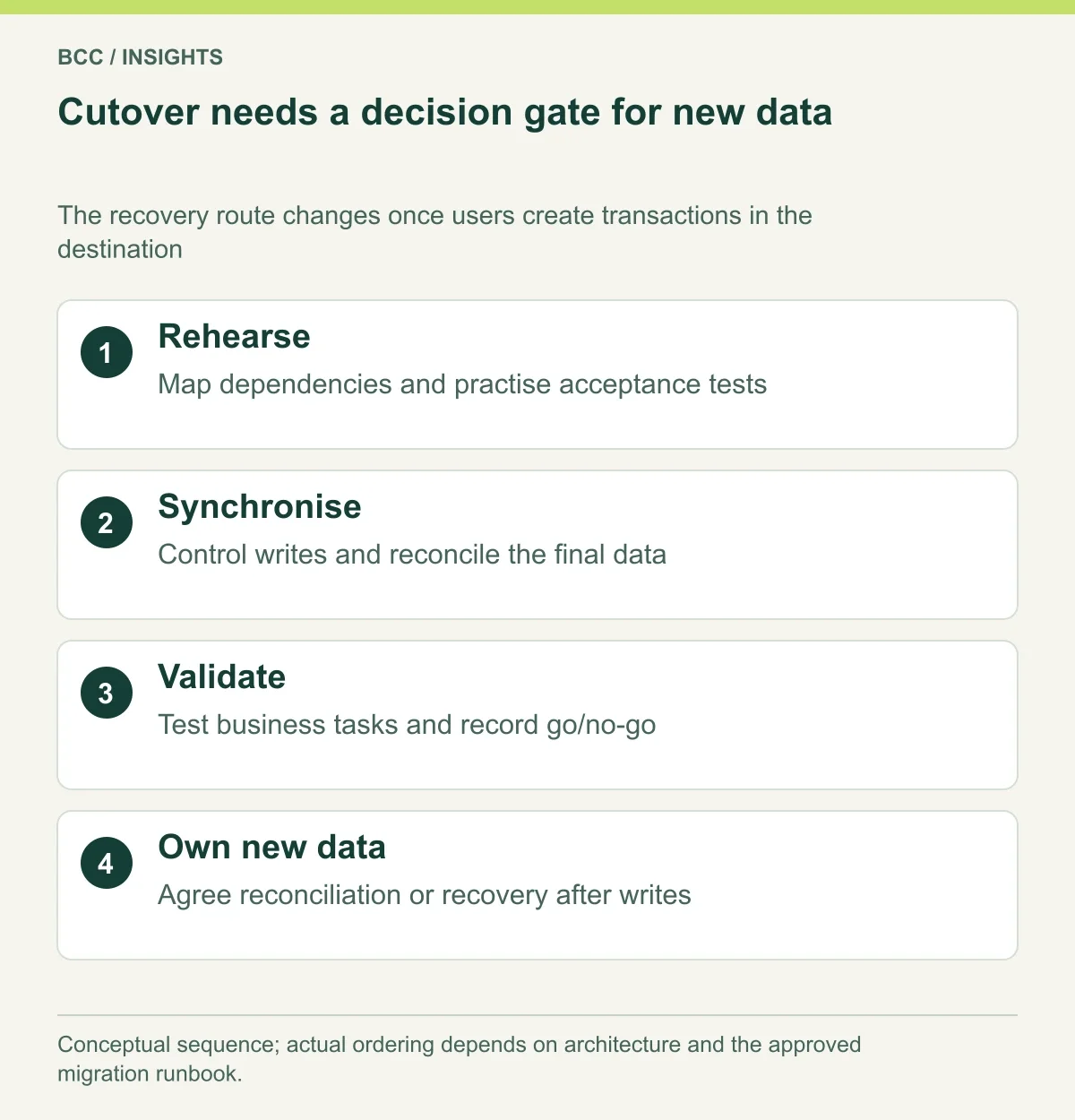
Cutover needs a decision gate for new data. Conceptual sequence; actual ordering depends on architecture and the approved migration runbook.
A restored endpoint is not necessarily a restored business
Consider a hypothetical ordering application moved to a new environment. Initial tests pass, customers place orders, and then a warehouse integration fails. Redirecting traffic to the old application might restore its screen while hiding orders created in the destination. The recovery plan must account for those records, their identifiers and any downstream actions already taken.
AWS distinguishes rollback before and after data changes. Once the destination receives writes, returning traffic may require data reconciliation or another recovery approach. This is why a generic instruction to change DNS back is incomplete. Dual writing and replication introduce their own consistency risks and should be designed and tested for the particular application.
Rehearse the decisions, not just the copy
A rehearsal should reveal missing permissions, realistic task durations and ambiguous acceptance criteria. Use representative non-production data and protect it appropriately. Exercise a failed acceptance check as well as a successful run. Ask the business tester to explain the evidence needed for approval and the operator to demonstrate access to the recovery instructions under the conditions expected during cutover.
At handover, document who monitors the application, who handles provider incidents and who maintains backups and configuration. Review actual performance and costs after migration rather than assuming the original sizing remains suitable. Keeping the old environment available briefly can be part of an approved plan, but its security, cost and retirement date also need an owner.
Record who communicates the decision to users and connected suppliers, and how they confirm which environment is authoritative. Include the treatment of queued work and scheduled jobs in the handover. These details help prevent staff from continuing transactions in an environment the technical team has already decided to retire.
Prepare for a specific workload
Discuss your dependency map and acceptance tasks with BCC through cloud consulting and cloud migration. For provider architecture choices, explore AWS and Azure cloud solutions. A useful first deliverable is a reviewed cutover runbook with explicit decisions about data, authority and recovery.
Sources
AWS Prescriptive Guidance: Pre-cutover stage — Undated maintained guidance; publication date not stated. Accessed during retrospective batch preparation.
AWS Prescriptive Guidance: Cutover stage — Undated maintained guidance; publication date not stated. Accessed during retrospective batch preparation.
Editorial date: 24 August 2026, assigned for this retrospective Insights series. Prepared and sources checked on 30 October 2026. Updated 30 October 2026.