



A connection between two business systems can fail in an awkward place: after the receiving system completes the work but before the sender gets confirmation. The sender sees a timeout. The receiving system may already have created the job or invoice. Sending the same instruction again without understanding that uncertainty can produce duplicate work, while simply giving up can leave staff with an unresolved transaction.
Agree what counts as one business action
An application programming interface, or API, is the agreed way one application requests work or information from another. Before implementing API development and system integration, define the business action behind each request. “Create this approved job” is different from “create another job with identical details”. An integration needs a reliable way to tell those intentions apart.
AWS's guidance on idempotent APIs describes using a client request identifier so repeated attempts can represent the same intended action. The receiving service must implement that agreement. Adding a random identifier to a request does nothing unless the API recognises it and preserves the relevant outcome.
Document when an identifier is created, where it is stored, how long the receiving system honours it and what happens if the payload changes. Reuse the identifier for another attempt at the same action. Give a genuinely new action a new identifier. Check these rules against the provider's documentation, including any limits that apply across accounts, endpoints or time windows.
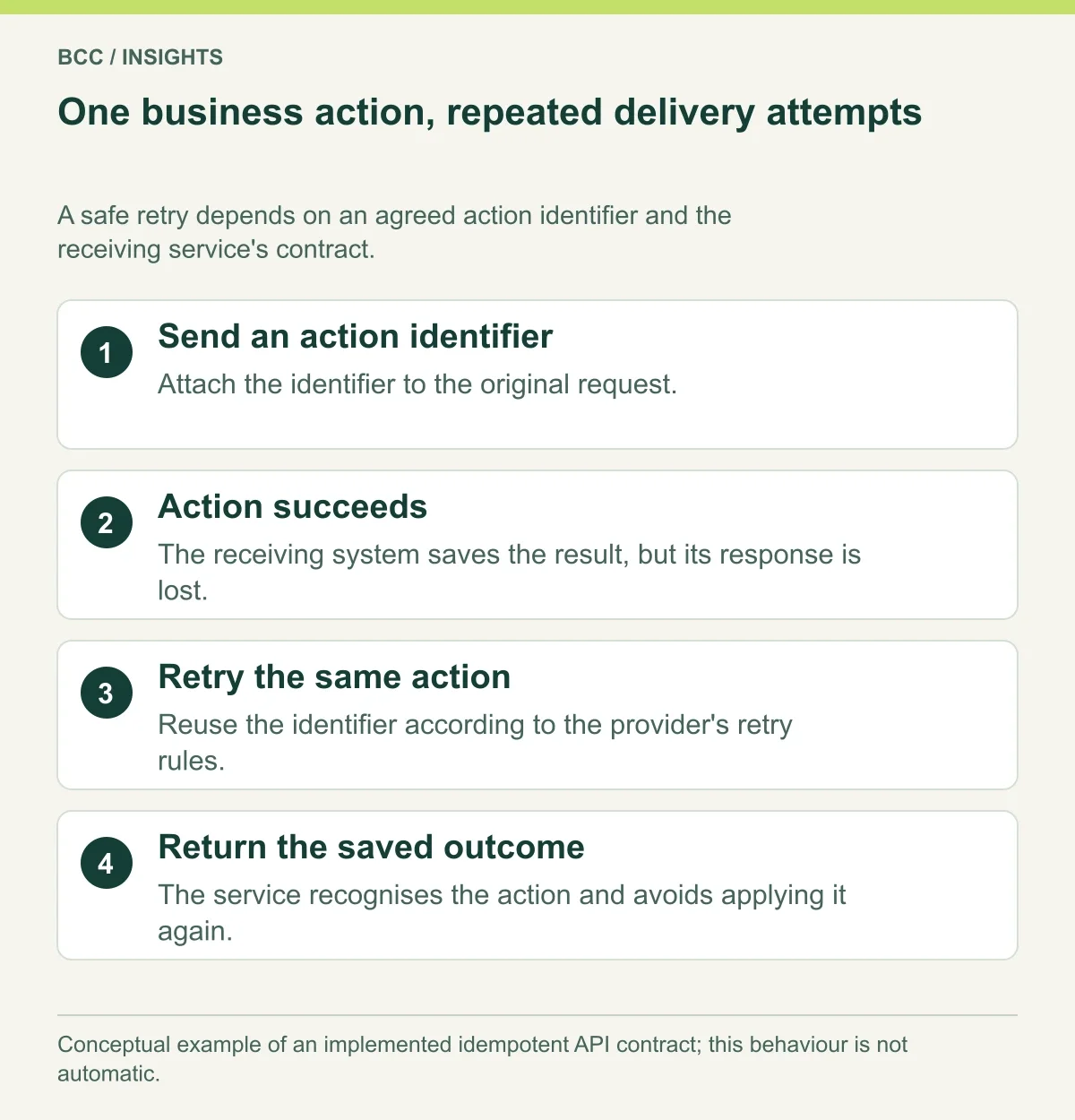
One business action, repeated delivery attempts. Conceptual example of an implemented idempotent API contract; this behaviour is not automatic.
Use retries where they can help
Temporary connection problems and some service failures may justify another attempt. Invalid data or missing permission usually need a different response. AWS's timeout and backoff guidance explains that retries can increase pressure on an overloaded service. Waiting between attempts, spreading retries with jitter and limiting attempts help control that pressure.
Choose timeouts and retry limits for the actual user journey. A person waiting for a booking confirmation needs a clear response; a background synchronisation may allow more time. Check what the provider's software library already retries so the application does not unknowingly retry the same request at several levels. Persistent failures need a visible resolution path.
The HTTP semantics standard distinguishes idempotent methods and limits automatic retries of non-idempotent requests. The practical lesson for a business owner is to ask for the API's documented behaviour. A method name, a timeout message or an optimistic assumption cannot establish whether repeating a particular business action is safe.
Make unresolved work visible
Suppose a hypothetical distributor sends an approved order from its sales application to a fulfilment platform. The fulfilment request times out. If the provider supports an appropriate idempotency contract, the sender can retry with the original action identifier. If it does not, the integration may need to query the provider for an external order reference or place the item in a reconciliation queue for review.
That queue should explain what was attempted, when it happened and what staff can safely do next. It should not encourage an operator to click “send again” without knowing whether an order exists. This example illustrates a design decision; it does not claim that any particular provider supports these features.
Use a failure review before launch
Simulate a lost response after the receiving system accepts the request.
Confirm that duplicate delivery produces the agreed business outcome.
Test invalid input, expired credentials, rate limits and a prolonged outage.
Check whether a failed item can be corrected and replayed without losing its history.
Assign ownership for alerts, reconciliation and changes to the provider's API.
Keep diagnostic records useful and proportionate: include correlation references and statuses while avoiding unnecessary sensitive payloads. Review the manual process with the people who will operate it. Business process automation should include the exception path as well as the successful transaction.
If your connected systems leave staff guessing which work completed, bring an example transaction and the provider documentation to a discussion about application support and maintenance. Start by making failure states understandable, then agree the safest recovery behaviour for each action.
Sources
AWS: Timeouts, retries, and backoff with jitter — Published and last modified 2019-12-05
AWS: Making retries safe with idempotent APIs — Published and last modified 2021-01-15
IETF RFC 9110: HTTP Semantics, section 9.2.2 — Published 2022-06
Editorial date: 4 September 2026, assigned for this retrospective Insights series. Prepared and sources checked on 30 October 2026. Updated 30 October 2026.