



A security checklist can show that a tool was purchased or a policy was approved. A useful improvement plan goes further: it shows which systems are covered, how the control was checked and who owns the remaining gap. That distinction matters when a business needs to decide where its next security effort should go.
Make the assessment boundary visible
Begin by naming the environment being assessed. Include the relevant workstations, servers, services, users and administration arrangements, along with exclusions. Record the date and any testing limitations. An assessment of head-office devices should not be presented as evidence for a branch environment that was never checked.
Next, choose a target suited to the organisation's operating environment and obligations. ASD's Essential Eight maturity model recommends progressing through maturity levels and reaching the same level across all eight strategies before moving higher. It also makes clear that Essential Eight is a minimum set of measures and cannot address every cyber threat.
The target should therefore support a risk decision, rather than serve as a badge. Consider business criticality, exposure and requirements in contracts or applicable policies. A cyber security assessment can establish the current position and make the difference between a known gap and an untested assumption explicit.
Ask what the evidence demonstrates
ASD's assessment process guide places greater weight on testing whether a control works than on policies or verbal statements. Configuration reviews also provide stronger evidence than a statement of intent. Choose suitable, authorised tests and record limitations so a decision-maker can understand the confidence behind each finding.
A patching policy, for example, describes an expectation. Evidence from the relevant devices and services helps establish whether that expectation is being met. Review the systems outside the usual management tools too. The question is whether the intended scope is protected, not simply whether a central dashboard is available.
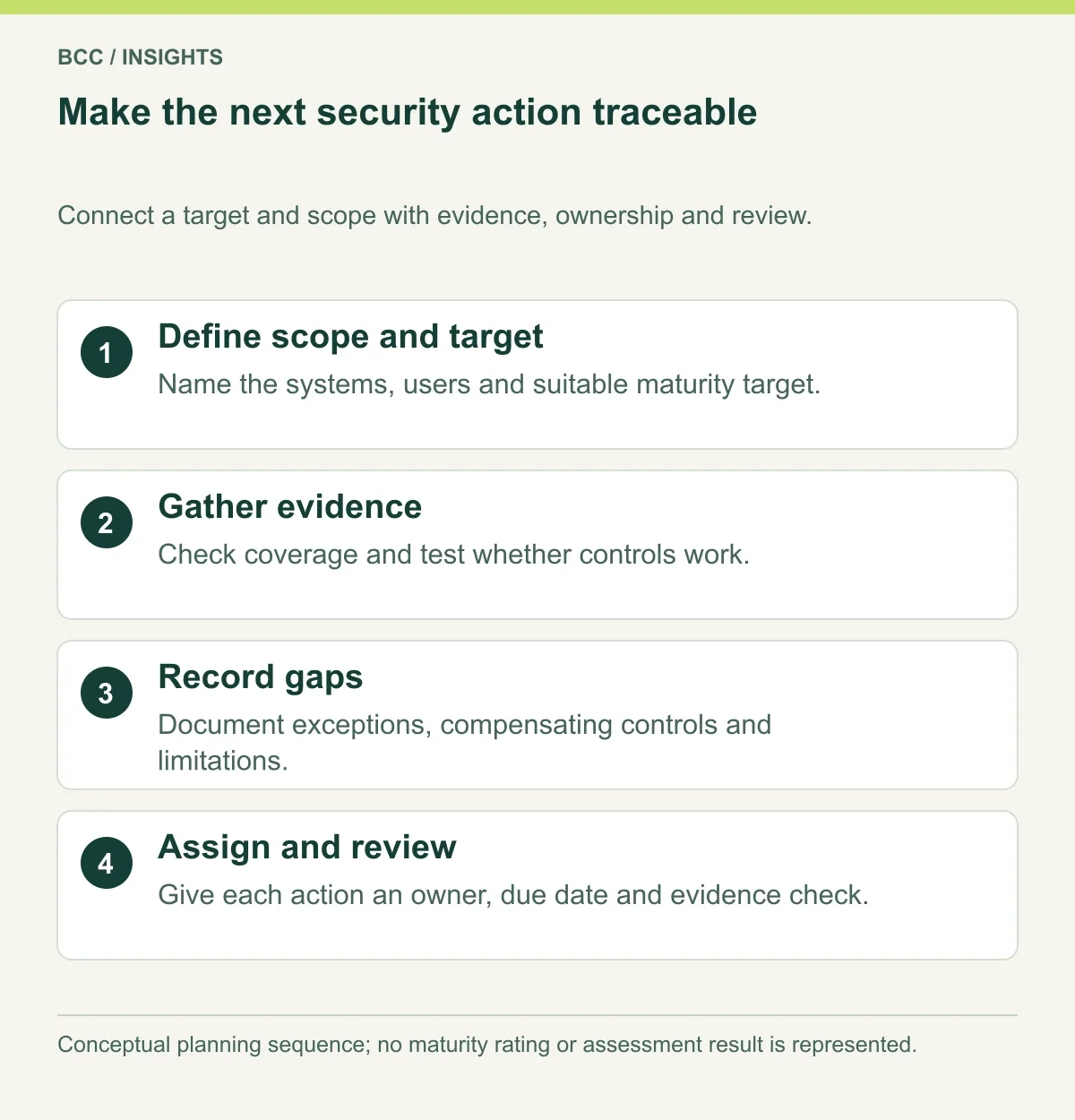
Make the next security action traceable. Conceptual planning sequence; no maturity rating or assessment result is represented.
Build a register people can act on
Control and scope: state the required behaviour and the systems or users it covers.
Evidence: record the source, collection date and what the check actually demonstrates.
Gap or exception: describe uncovered assets, failed checks and any limitation on testing.
Risk treatment: identify compensating controls and the decision approving an exception.
Action and owner: name the accountable person, due date and evidence needed to close the gap.
Keep the register readable enough for the business owner to use. Technical detail can sit behind the finding, but the next action should be concrete. Replace an instruction such as improve patching with a defined investigation or remediation task for identified systems. Review exceptions periodically, including whether the reason for them still applies.
A fictional wholesaler's first review
Consider a fictional wholesaler assessing its office network and warehouse workstations. Its existing checklist marks application patching as implemented because a management platform is installed. During the scoped review, the team discovers that a specialised dispatch workstation is managed separately and has no recent evidence in the assessment.
The team records the coverage gap, confirms the dispatch system's support requirements with its owner and assigns a patching review. It also documents temporary risk treatment while that work is planned. The item remains open until suitable evidence is available. This is an illustrative decision path, with no claimed maturity rating or security result.
Turn findings into a balanced work programme
Keep the assessment scope stable while comparing progress. When new systems join the environment, record the expansion so an improved result is not confused with a change in what was measured.
Review the gaps across all eight strategies before committing the whole budget to one mature area. Sequence work around risk, dependencies and available maintenance windows. Some findings may require patch and vulnerability management; others need changes to access, applications or recovery arrangements. Keep the business owner involved when remediation affects operations.
Bring BCC your existing checklist, the systems it is intended to cover and any contractual security requirements. Our cyber security consulting can help turn those inputs into a scoped evidence plan with prioritised actions and clear ownership. The useful next step is a position you can substantiate and improve.
Sources
ASD: Essential Eight maturity model — Published 2017-06-30, reviewed 2023-11-27; minimum preventative measures, not protection against every threat.
ASD: Essential Eight assessment process guide — Published 2022-11-24, reviewed 2024-10-02; assessment guidance for the November 2023 maturity model.
Editorial date: 27 August 2026, assigned for this retrospective Insights series. Prepared and sources checked on 30 October 2026. Updated 30 October 2026.