



A supplier needs access to finish a project, so a firewall exception is approved. Months later, the project has ended and the rule remains. The original request may be buried in an email account nobody checks. This is an ownership problem as much as a configuration problem. A useful firewall record follows the rule throughout its life, including the decision to remove it.
Describe a business need precisely
Before discussing technical settings, identify the task that requires connectivity and the person accountable for it. Then record the proposed source, destination, service and direction of traffic. Avoid treating a broad request to make an application work as sufficient approval for unrestricted access. Where the required connections are unclear, establish them with the application owner and supplier before implementing the change.
NIST's firewall policy guidance recommends formal control of rule changes and periodic review or testing. Although published in 2009, its policy and management principles remain a useful reference; specific implementation details must follow the current product documentation. A business should not mistake an old configuration example for instructions appropriate to its present network.
Plan the failed change as carefully as the successful one
A firewall change can affect more than the requested application. Identify dependent services, remote administration paths and the management access needed if connectivity breaks. Capture the relevant approved configuration before making changes, and confirm who can restore it. A rollback procedure that requires the connection the change might remove needs an alternative access method agreed beforehand.
Request: business purpose, named owner and expected end date.
Scope: the minimum justified endpoints and services, with environment identified.
Approval: an authorised decision-maker and any accepted exposure.
Execution: change window, operator, configuration reference and recovery route.
Verification: permitted traffic works, unrelated access stays restricted, and logs are checked.
Review: an expiry decision, evidence of ongoing need or confirmed removal.
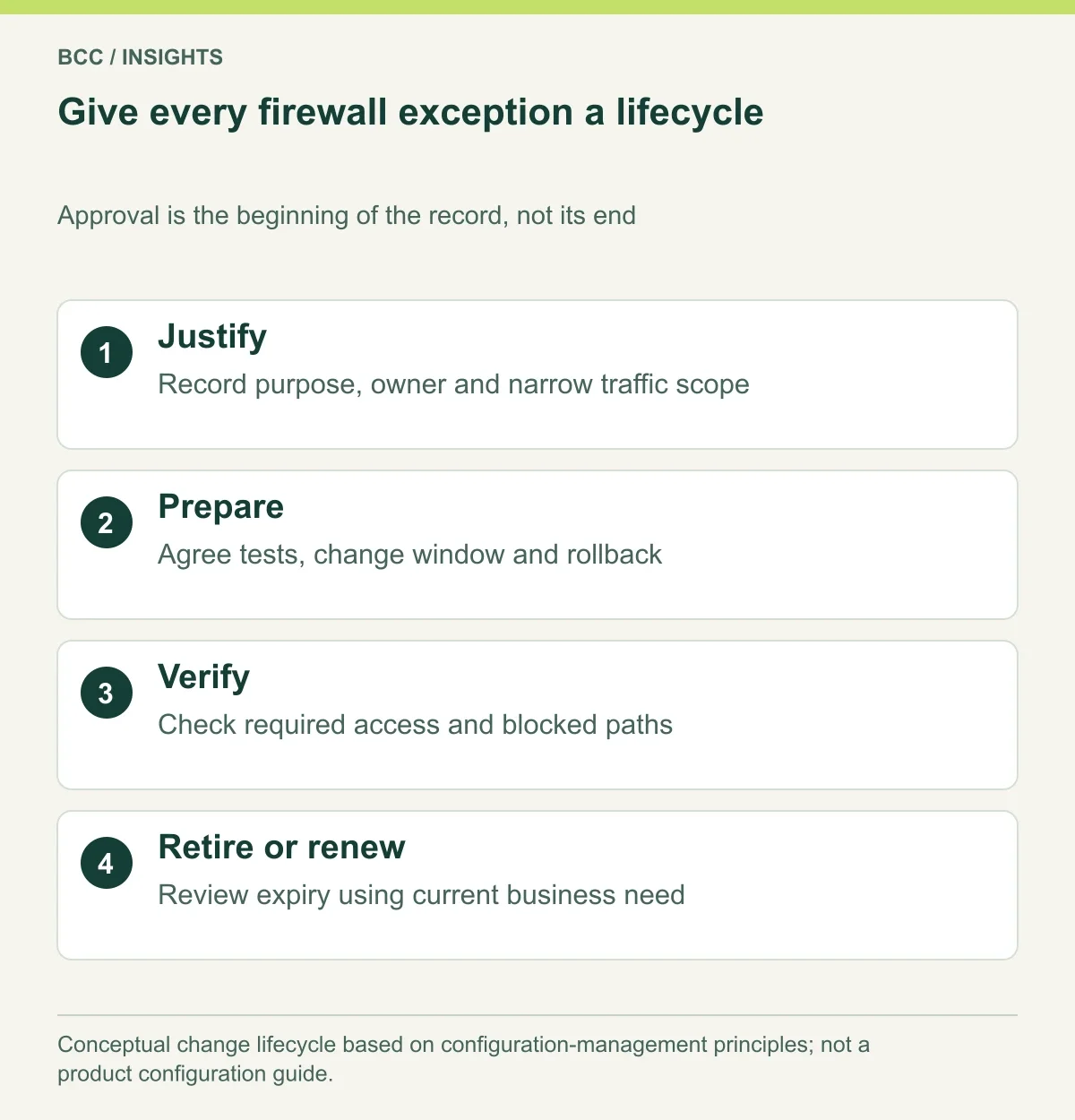
Give every firewall exception a lifecycle. Conceptual change lifecycle based on configuration-management principles; not a product configuration guide.
Use an exception that can actually expire
Imagine a hypothetical business giving a vendor access to a test application for a short acceptance exercise. The record identifies the test environment and sponsor, states that production access is excluded, and schedules a review when the exercise ends. Whether expiry is enforced by the firewall or by a tracked task, someone must verify that the connection is removed or deliberately renewed.
Do not silently delete a rule just because its date has passed. Check its current use and contact the owner so removal follows the appropriate change process. Unexpected usage may reveal a newly adopted dependency, an inaccurate rule description or access that should be investigated. The objective is controlled access, supported by evidence, rather than a cosmetic reduction in the rule count.
Treat the approved configuration as a maintained record
NIST SP 800-128 describes security-focused configuration management as an ongoing activity. For a business network, a practical application is to connect each material exception to its approval, current configuration and verification record. Record emergency changes promptly and bring them back through normal review instead of allowing urgency to erase accountability.
When reviewing existing rules, start with those whose purpose or owner is unknown, broad administrative access and temporary supplier arrangements. Prioritise using business context and exposure; a numerical age threshold alone cannot tell you whether a rule is necessary or safe. Record unresolved questions and assign an owner rather than treating an incomplete review as assurance.
Build a manageable review cycle
BCC's network and firewall management and IT infrastructure support can be scoped around documented changes and operational verification. Where the wider exposure is uncertain, discuss a cyber security assessment. Bring a sample of current exceptions to the conversation and identify which decisions need clearer ownership first.
Sources
NIST SP 800-41 Revision 1: Guidelines on Firewalls and Firewall Policy — 2009-09-28
NIST SP 800-128: Security-Focused Configuration Management — 2019-10-10 update
Editorial date: 20 October 2026, assigned for this retrospective Insights series. Prepared and sources checked on 30 October 2026. Updated 30 October 2026.