



A crowded monitoring dashboard can make an environment look well understood. Yet a business can receive dozens of resource warnings while missing the failed overnight job that stops staff doing their work. Useful monitoring starts with a question about the service: what would we need to know to take a worthwhile action? The answer determines both the checks and the response arrangements.
Observe the task as well as the machine
CPU, memory and disk measurements help diagnose constraints. They do not prove that users can complete an important transaction. Google's SRE monitoring chapter distinguishes internal observations from checks of externally visible behaviour. For a smaller organisation, that can mean pairing server health with a safe test of the application path staff rely on.
Take a hypothetical reporting service. Checking that its scheduled process started is useful, but the operational outcome is a current, readable report delivered to the right place. Add a check for freshness and expected output, designed so it does not expose sensitive report contents. Record who decides whether a missing report is urgent and what happens when that person is unavailable.
Separate signals that need different responses
An alert that wakes someone should justify immediate interruption. A capacity trend might instead create planned work, while a brief fluctuation may belong only on a dashboard. Make these decisions using the business's tolerance for disruption. An overnight failure may matter immediately to an online retailer and at the next support window to a non-critical internal tool; neither assumption belongs in a generic monitoring template.
Immediate action: a significant user task is failing and an agreed responder can intervene.
Planned investigation: a sustained trend threatens a future limit but allows time to act.
Diagnostic context: a measurement helps explain events without generating another interruption.
Escalation: the first responder cannot restore service or lacks the required authority.
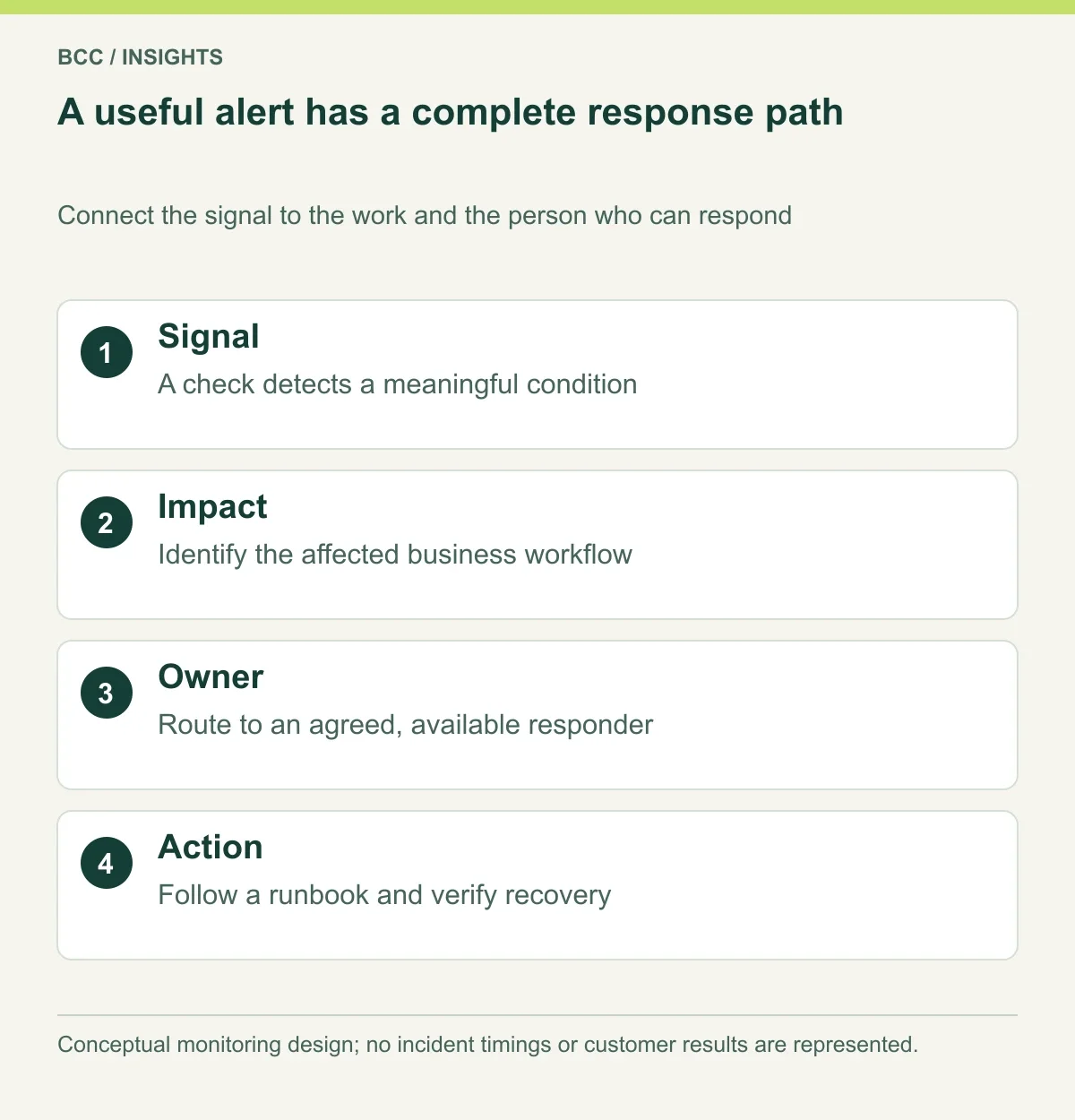
A useful alert has a complete response path. Conceptual monitoring design; no incident timings or customer results are represented.
Give the responder enough context
Write notifications so someone can recognise the affected service, condition, first investigation step and runbook location without searching several systems. Include recent changes where available. Avoid sending secrets, customer records or unrestricted log extracts into email or chat. Monitoring access and retention need their own ownership because operational records can contain commercially sensitive details.
The Google SRE Workbook describes testing monitoring rules and alert routing. A practical adaptation is to exercise one safe failure condition and verify its journey: detection, delivery, acknowledgement, investigation and closure. Test an unavailable responder as well as the happy path. A configured address is weak evidence if nobody checks it during the contracted coverage period.
Review usefulness, not just alert volume
At the next review, examine a sample of recent notifications. Which led to a useful action? Which repeated the same incident? Which were ignored because they lacked a clear owner? Record the reason before removing a check or changing its threshold. Reducing noise is valuable only if the remaining signals still reveal the failures the organisation needs to detect.
Also ask what users reported before monitoring noticed. Those gaps often reveal missing dependency checks or assumptions about normal activity. Keep any proposed targets explicit: detection time, response time and restoration time describe different parts of the process. Their interpretation should follow the agreed support arrangement rather than the presence of a monitoring platform.
Agree how planned maintenance affects notifications, including who starts and ends any suppression. After the work, verify that the checks and routing are active again. Keep a record of disabled checks with an owner and review date so a temporary workaround does not quietly remove visibility from an important service.
Define the monitoring boundary
Infrastructure monitoring focuses on availability and resource health. Security monitoring examines suspicious activity and requires different investigation decisions. Discuss both boundaries with BCC, including how managed server support receives and acts on operational findings. Start with one critical workflow and prove its response path before adding more alerts.
Sources
Google Site Reliability Engineering: Monitoring Distributed Systems — 2016 book
Google Site Reliability Workbook: Monitoring — 2018 book
Editorial date: 10 September 2026, assigned for this retrospective Insights series. Prepared and sources checked on 30 October 2026. Updated 30 October 2026.