


A staff member asks an internal AI assistant which travel expenses need approval. The answer sounds clear and cites a policy. Two questions still matter: is that the current policy, and should this user be able to see every document the assistant consulted? A useful knowledge assistant needs evidence for both answer quality and access control.
Start with a collection someone owns
Choose one maintained body of information, such as approved operating procedures, before connecting every shared drive. Give each source an owner, an effective date and a review process. Remove superseded copies from the assistant's intended collection or mark their status explicitly. If two documents conflict, resolve the policy question with the business owner rather than expecting the assistant to choose.
For AI chatbots and virtual assistants, this preparation helps define a service users can understand. State what the assistant covers, where its answers come from and when staff should refer a question to a person. Keep consequential approvals within the agreed business process.
Confirm how access works in this product
Microsoft says Copilot grounds responses in data the user already has permission to access. Its foundational deployment guidance recommends addressing oversharing and governing high-risk sites and files. Existing access therefore needs review: the assistant's intended audience and the source collection should match the business's information rules.
That behaviour is product-specific. A custom assistant may use a shared service identity or a separate index, so its access model needs explicit design and testing. Ask how source permissions reach the retrieval layer, what happens when access is removed, and whether answers or conversation history can be shared. Include these questions in AI integration planning.
The OAIC's commercial AI guidance recommends due diligence covering intended use, human oversight, privacy risks and access to personal information. It advises against entering personal information into public generative AI tools as best practice. Check which obligations apply to your organisation and how the chosen product handles information.
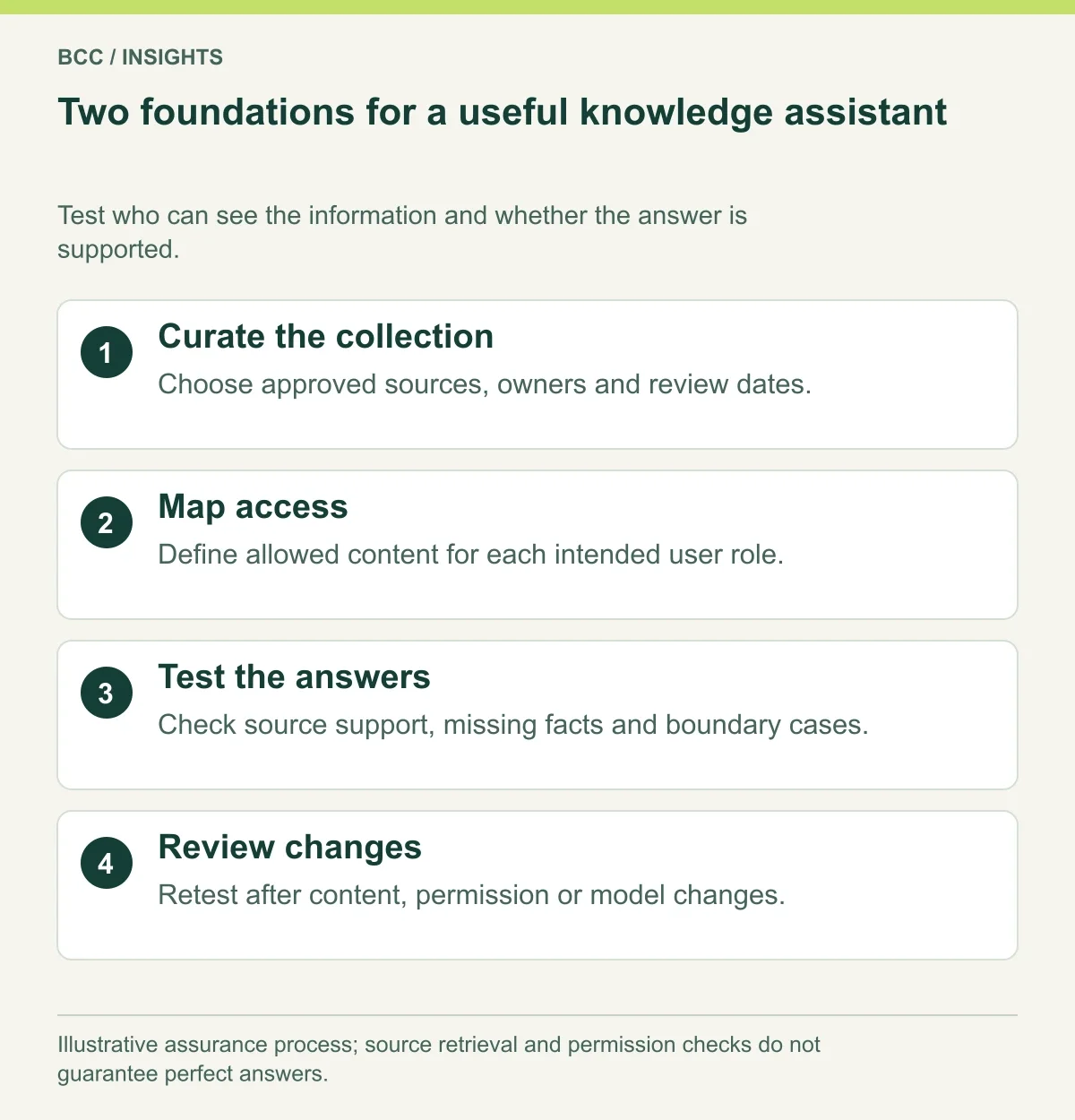
Two foundations for a useful knowledge assistant. Illustrative assurance process; source retrieval and permission checks do not guarantee perfect answers.
Build a test set that can disappoint you
Use real questions supplied by staff, with an approved expected answer or reference where possible. Check the source passages as well as the response: a citation can point to a document without supporting the particular statement. Include questions that the collection cannot answer, so the team can assess whether the assistant acknowledges the gap and offers an appropriate escalation.
Routine questions: does the answer provide the relevant steps without adding unsupported conditions?
Conflicting or old sources: does the response rely on the approved current material?
Missing information: does the assistant explain what it cannot establish?
Restricted information: do tests with different user roles preserve the intended boundaries?
Follow-up questions: does the response remain supported as the conversation develops?
A fictional policy assistant, tested narrowly
Consider a fictional engineering practice piloting an assistant for its staff handbook. A project coordinator asks how to request professional development. The expected answer links to the current procedure and identifies the approval role. To test access separately, the team adds a synthetic management appendix to the test collection and gives only the manager role permission to read it.
The pilot owner asks a question that requires that appendix using both roles. The coordinator must not receive its restricted content; the authorised manager should be able to retrieve the permitted information. This checks an access boundary rather than only the absence of a source. If an old handbook produces conflicting advice, the owner fixes the collection and reruns the tests. This bounded example claims no achieved result or guarantee about future answers.
Keep the answer service maintained
Retain the question, expected source and reviewer decision for each test case. That record makes a future comparison possible when the system or knowledge collection changes.
Record failures and give users a simple way to report questionable answers. Retest after changes to source documents, access rules, prompts or models. Include Microsoft 365 security where the assistant uses that environment, and nominate a business owner who can resolve content disputes.
Bring BCC one proposed knowledge collection, its owners and a sample of staff questions. Through generative AI solutions, we can help define the access model, answer tests and operating responsibilities for a focused assistant before its scope grows.
Sources
Microsoft: Secure and govern Copilot — Foundational deployment guidance — Last updated 2026-08-18; describes Microsoft's product-specific permission and deployment model.
OAIC: Privacy and commercially available AI products — Published 2024-10-21, updated 2025-01-17; privacy applicability depends on the organisation and circumstances.
DTA: Appendix 2 — AI evaluation — Parent guidance last updated 2026-03-11; government evaluation reference, not a guarantee of answer accuracy.
Editorial date: 23 October 2026, assigned for this retrospective Insights series. Prepared and sources checked on 30 October 2026. Updated 30 October 2026.