


A managed IT proposal can list monitoring, maintenance and support while leaving the most consequential question unanswered: who acts when an important business task stops working? For a business comparing providers, a responsibility map is often a better starting point than a long tool list. It makes the service easier to buy, operate and review.
Start with the work the business depends on
Choose a few important activities: staff signing in, producing invoices, accessing shared documents or processing customer orders. For each, identify the application, server, identity service, network and external supplier involved. A server may be available while the business activity still fails. The agreement should say which parts the provider manages and who coordinates the rest.
Record ownership of domains, subscriptions, administrator accounts and recovery information. Keep business ownership separate from permission to perform technical work. An employee who approves expenditure may need a different role from the technician who applies a change. This becomes particularly important when several suppliers support one workflow.
Translate coverage into actions and evidence
For every recurring task, ask what triggers it, who performs it and what record demonstrates completion. A maintenance item might produce a change record, verification result and list of exceptions. Monitoring should identify the destination of alerts and the person responsible for triage. Google's monitoring guidance distinguishes collecting signals from the human notifications they generate; buying one does not automatically define the other.
Scope: supported assets, locations, operating systems and explicit exclusions.
Coverage: agreed support hours, contact channels and treatment of work outside those hours.
Priority: business impact definitions and separate response, restoration and resolution expectations.
Authority: who approves disruptive changes, emergency expenditure and accepted exceptions.
Evidence: maintenance records, incident summaries, unresolved risks and review ownership.
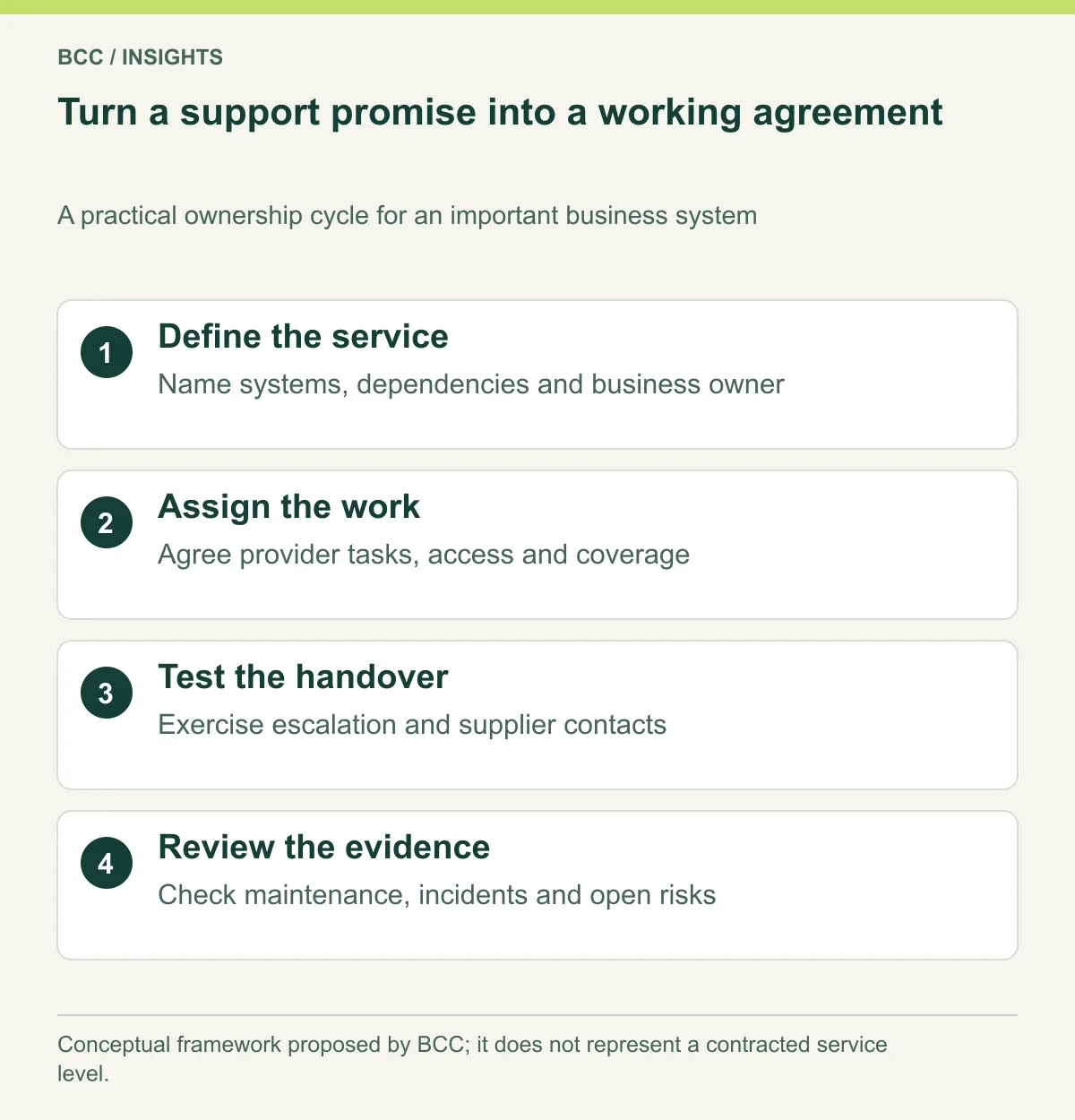
Turn a support promise into a working agreement. Conceptual framework proposed by BCC; it does not represent a contracted service level.
Exercise an awkward handover before it matters
Consider a hypothetical wholesaler whose invoicing software is maintained by one vendor and whose server is managed by another. Staff can log in, but invoices fail to export. If each supplier can close its ticket because its component is running, the business still has no working process. Assign an incident coordinator, record both supplier contacts and define what evidence accompanies an escalation.
Walk through that scenario with the proposed provider. Ask who checks the export queue, who can view relevant logs and who confirms a valid invoice reaches the destination. The exercise is not a promise that faults will disappear. It exposes missing permissions and handovers while there is time to fix them, and gives the business a concrete acceptance test for the support arrangement.
Make documentation usable by another person
A procedure that only its author can execute leaves a continuity gap. AWS recommends runbooks that identify the outcome, permissions, error handling and escalation path, and validation by another team member. Apply that idea to the few procedures whose absence would hurt most: renewing a certificate, restarting an agreed service or contacting a critical supplier.
Finally, agree how access and records transfer when the engagement ends. The business should know where its documentation lives and how it receives current configuration and account information. At each service review, pick one completed task and one unresolved risk to examine. This produces a more useful conversation than a dashboard full of activity counts without business context.
Request a sample service record before agreeing the reporting format. Check whether it identifies the affected system, action, verification and unresolved follow-up. Decide which records the business retains independently of the provider, and who keeps the responsibility map current when an application, supplier or business owner changes.
Prepare a scope you can compare
Bring your critical workflow list and responsibility map to a discussion about managed IT services. Where responsibilities are narrower, compare managed server support and IT infrastructure support. Ask BCC to help define the coverage and evidence appropriate to your environment before selecting an ongoing arrangement.
Sources
AWS Well-Architected Framework: Use runbooks to perform procedures — 2023-10-03 version
Google Site Reliability Engineering: Monitoring Distributed Systems — 2016 book
Editorial date: 4 August 2026, assigned for this retrospective Insights series. Prepared and sources checked on 30 October 2026. Updated 30 October 2026.