



MFA enabled is an encouraging setting to see, but it is only the start of a useful identity review. A business needs to know which accounts must use it, which methods they use and which access paths remain outside the policy. Recovery procedures deserve the same attention: staff need a workable way back in without creating an easy bypass.
Review strength and coverage together
ASD's MFA implementation guidance recommends phishing-resistant authentication across online services, systems and data repositories. It explains that methods differ in effectiveness and that protecting remote access alone can leave other access exposed. Security keys and supported device-protected public-key methods are options to evaluate for the relevant environment.
A review should distinguish the product's available features from the policy actually enforced for a user. Check ordinary staff, administrators, contractors and other relevant account classes. Ask about older applications and alternative sign-in routes. An enrolment report can help with the investigation, but it should be accompanied by checks of the intended access behaviour.
For organisations using Microsoft's environment, a Microsoft 365 security review can examine identity settings alongside the services they protect. Keep a record of applications outside that environment so the review has a clear boundary.
Map the paths before choosing the rollout
Email and collaboration: identify the accounts, applications and sign-in methods staff actually use.
Administrative access: list privileged accounts and how administrators reach management interfaces.
Remote and internal access: include the relevant gateways, workstations and direct application access.
Business SaaS: confirm whether central policies apply or the service has its own authentication settings.
Recovery and exceptions: document lost-device handling, temporary access and authorised exclusions.
For each path, record its owner, enforced method, affected users and evidence of testing. If an application cannot support the intended method, document the constraint and agreed treatment. Give that exception a review date rather than allowing it to become an undocumented permanent arrangement.
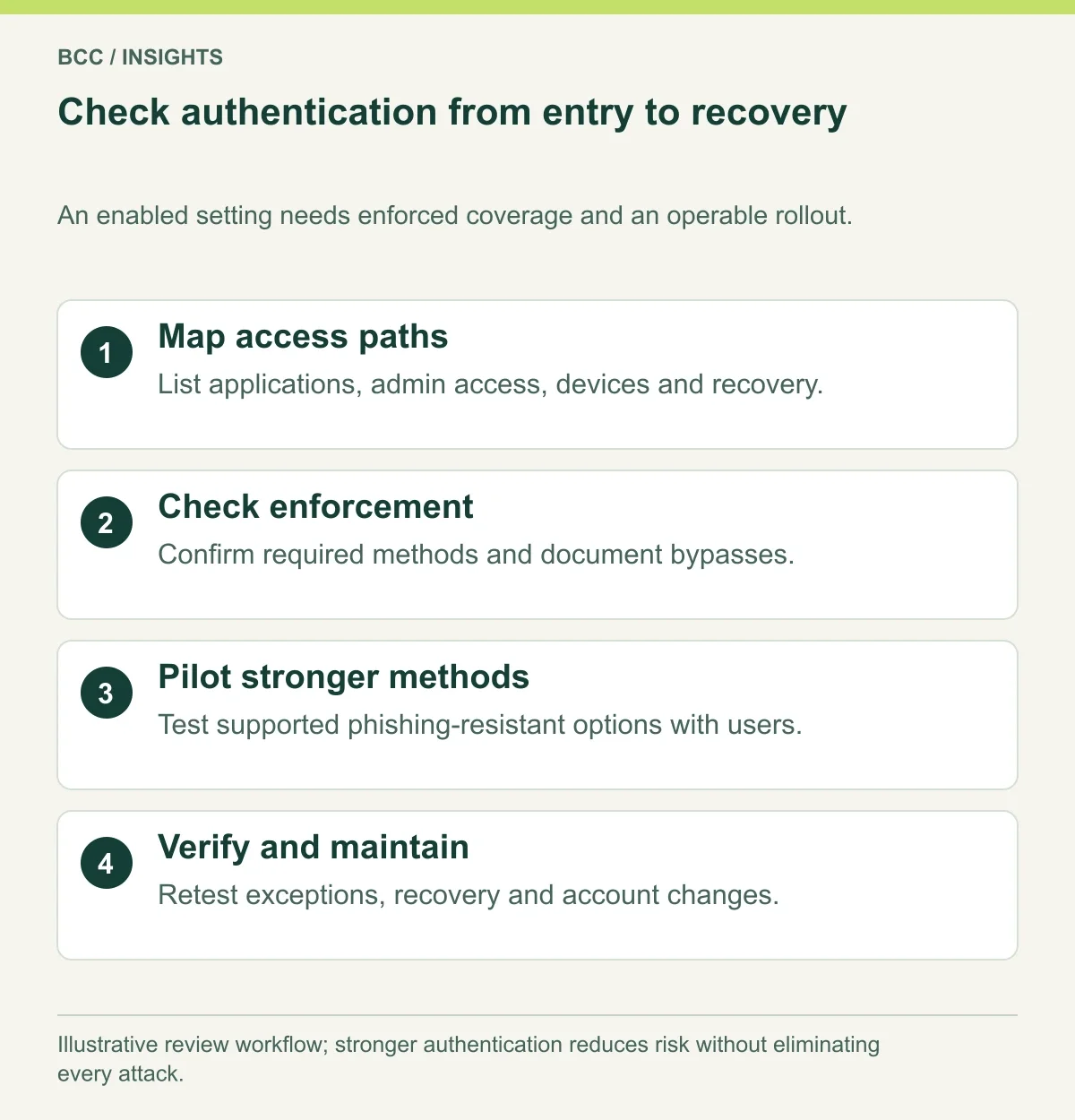
Check authentication from entry to recovery. Illustrative review workflow; stronger authentication reduces risk without eliminating every attack.
Make stronger authentication usable
Choose phishing-resistant methods that the services and devices support, then pilot them with representative staff. Include people working remotely, users of shared equipment and staff with accessibility needs. Check enrolment, routine use, replacement and loss reporting. A rollout plan should specify who provides support and how identity is verified during recovery.
Where Essential Eight assessment is relevant, consult the exact requirements for the target. ASD's maturity model differentiates MFA requirements by maturity level and access type. Avoid assuming that one method or a single successful sign-in establishes coverage for the entire environment.
A fictional practice checks a second route
Consider a fictional accounting practice reviewing authentication for its staff. Its cloud email requires MFA, while a separate document portal has its own sign-in policy. The review owner records both services and tests their access using an authorised test account. The portal's recovery route is included in the review because it can change how staff regain access.
The practice plans a supported phishing-resistant method for the pilot group and writes a lost-device procedure before expansion. It tests normal sign-in and recovery, records unresolved compatibility questions and assigns an owner to each exception. This example describes the review process; it does not claim that a particular configuration meets every assurance requirement or prevents every attack.
Keep evidence as the environment changes
Verify the policy with controlled tests after rollout and retain the result against the access path. Check new applications and account changes against the same inventory. Review whether temporary exceptions were removed and whether support staff can follow the recovery procedure. Include monitoring and incident escalation responsibilities in the operating arrangement.
An approach to zero trust security can place these identity decisions alongside device and access controls. MFA remains one part of protecting a service, so the review should also identify where other controls need attention.
Bring BCC your application list, current MFA policies and known exceptions. A focused cyber security assessment can help establish which methods are enforced, where coverage is uncertain and what a practical improvement sequence should include. Start with evidence about the access paths your business depends on.
Sources
ASD: Implementing multi-factor authentication — Published 2012-01-01, reviewed 2023-11-27; method and implementation guidance, not a guarantee against all compromise.
ASD: Essential Eight maturity model — Reviewed 2023-11-27; MFA requirements vary by maturity level and access type.
Editorial date: 17 September 2026, assigned for this retrospective Insights series. Prepared and sources checked on 30 October 2026. Updated 30 October 2026.