


A legacy application can be difficult to change while still carrying essential business knowledge. Staff may rely on its unusual approval rules, historical reports or undocumented exports. A modernisation project needs to discover that knowledge and decide which behaviour still serves the organisation. Choosing a new platform is only one part of the work.
For a large or tightly connected system, replacing a bounded business capability can provide a manageable starting point. The plan must explain how the existing and replacement components will coexist, where authoritative data lives and what allows the old component to be retired. Without those decisions, a temporary transition can become another permanent layer to maintain.
Begin with the outcome and the boundary
Describe what should become easier or more supportable: changing a pricing rule, processing an application or maintaining a supplier record. Identify who uses the capability, which records it owns and which systems depend on its outputs. A screen is not necessarily a useful boundary if its business rules are spread across scheduled jobs, reports and database procedures.
Martin Fowler's account of the Strangler Fig approach emphasises clear outcomes, smaller parts and transitional architecture that allows old and new to coexist. This is architectural guidance rather than a guarantee about cost or delivery time. Its value for a planning discussion is the attention it gives to finding workable boundaries.
Start legacy software modernisation with people who understand the daily work and people who understand its technical dependencies. Record the awkward exceptions as well as the usual path. An infrequently used month-end export can matter more to the business than a frequently opened screen.
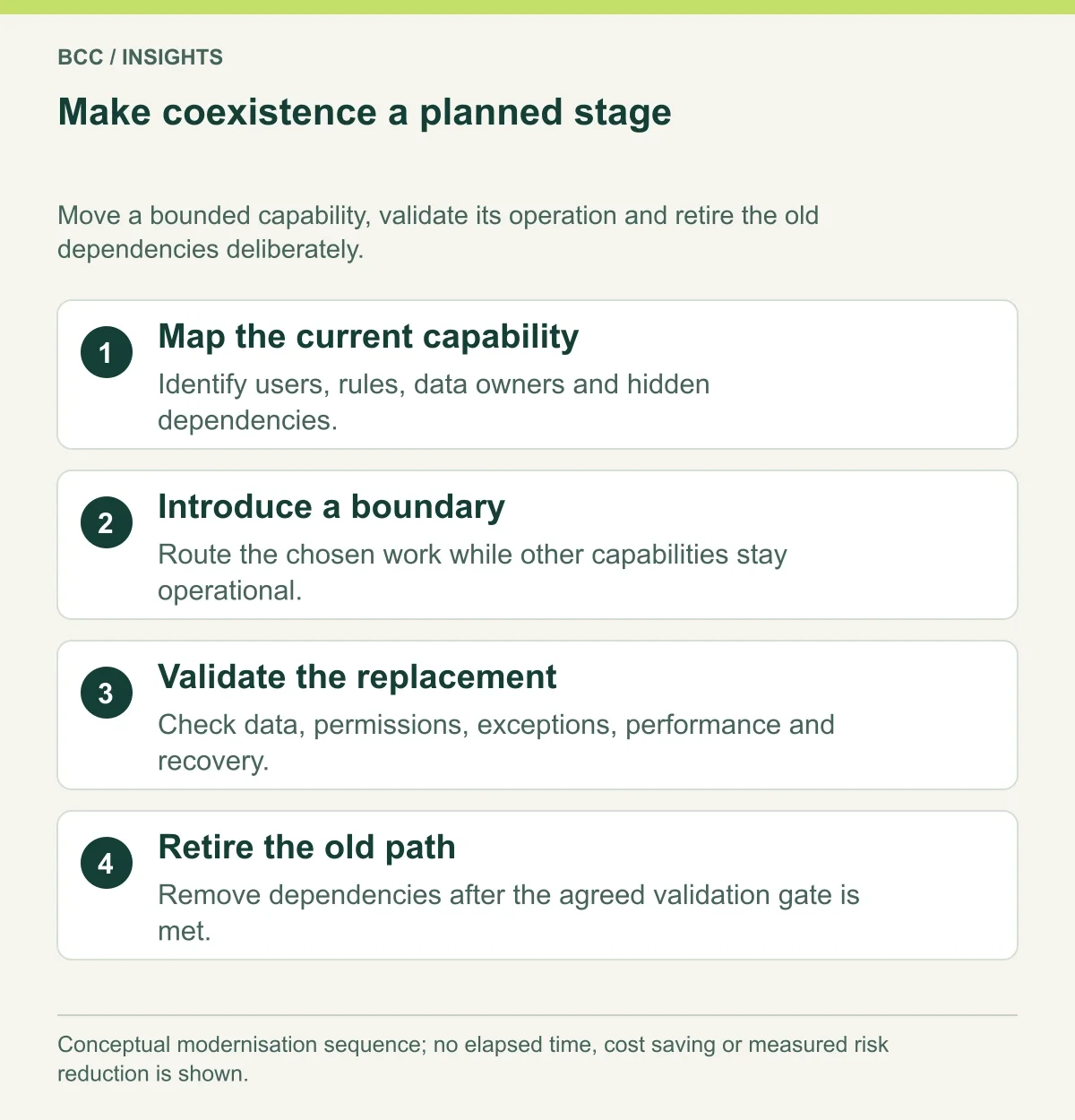
Make coexistence a planned stage. Conceptual modernisation sequence; no elapsed time, cost saving or measured risk reduction is shown.
Choose a first capability you can validate
Business value: identify the problem the replacement will address and who can confirm that it is resolved.
Boundary: establish how requests reach the capability and which dependencies must remain available.
Data ownership: name the system allowed to update each record during the transition.
Operational fit: check who supports both components and how incidents will be diagnosed.
Exit conditions: define what evidence permits the legacy function and its supporting infrastructure to be removed.
A small, self-contained application can justify a coordinated replacement. An urgent requirement to retire an unsupported platform can also change the sequencing. Compare feasible approaches against the organisation's constraints before committing to a gradual migration simply because it has an appealing name.
Budget attention for the overlap
The Microsoft Strangler Fig pattern describes routing requests between existing and new services. It highlights shared data, cross-system dependencies and the possibility that the routing layer becomes a bottleneck or failure point. These concerns belong in the design and operating budget, along with temporary infrastructure.
Agree how records move, when they become authoritative in the replacement and how discrepancies are resolved. If two systems can update the same information, specify how conflicts are detected and handled. A rollback plan also needs to account for new data created since the change; switching traffic back may not restore a coherent business state.
A hypothetical supplier workflow
Imagine a wholesaler whose old application handles purchasing, stock and supplier contact details. The team considers moving supplier contact maintenance first. Before doing so, it discovers that a nightly purchasing export reads those details directly from the old database. That export is part of the capability's dependency map, even though users never see it.
A bounded pilot could validate contact updates, permissions and the export before expanding access. Purchasing and stock remain operational through agreed interfaces. This illustrative example has no assumed savings or timetable. Its central decision is who owns a contact record at each stage and how every dependent process receives the correct version.
Make retirement an explicit deliverable
Maintain a retirement checklist for old jobs, permissions, reports, integrations and infrastructure. Keep the business owner involved in deciding which historical information must remain accessible. Schedule training and support alongside the technical change so staff understand the new process and how to report exceptions.
Custom software development can implement the replacement capability, while application support and maintenance can help plan the transition and ongoing ownership. Bring one difficult business workflow and its known dependencies to the discussion. That gives a modernisation assessment a concrete starting point and a clearer definition of completion.
Sources
Martin Fowler: Strangler Fig — Published 2024-08-22
Microsoft Azure Architecture Center: Strangler Fig pattern — Updated 2026-06-02
Editorial date: 13 October 2026, assigned for this retrospective Insights series. Prepared and sources checked on 30 October 2026. Updated 30 October 2026.