


An MVP, or minimum viable product, should make the next investment decision easier. For a business commissioning software, that means learning whether a defined group can complete a useful task and whether the organisation can support it. A small feature list alone does not establish either point. Start by describing the outcome you need, then decide the smallest release that can produce credible evidence about it.
Write the outcome before the requirements
Use a sentence with a person, a task and a result: a coordinator can assign an incoming job and see that the technician has accepted it. This is specific enough to test. “Build a job management platform” leaves too many questions unresolved. Speak with the people who perform the work, observe exceptions and check what already exists before deciding that new software is the right response.
The Australian Digital Service Standard provides a useful reference: validate the problem, understand users and establish meaningful measures. Its requirements apply within its stated Commonwealth scope; private businesses can adapt the principles. For your own brief, record:
The intended user and the complete task they need to finish.
The current process, including spreadsheets, calls and manual approvals.
The assumption that could invalidate the idea, such as unavailable integration data.
The evidence that would justify continuing, and the evidence that would prompt a rethink.
The person responsible for reviewing results and making the next scope decision.
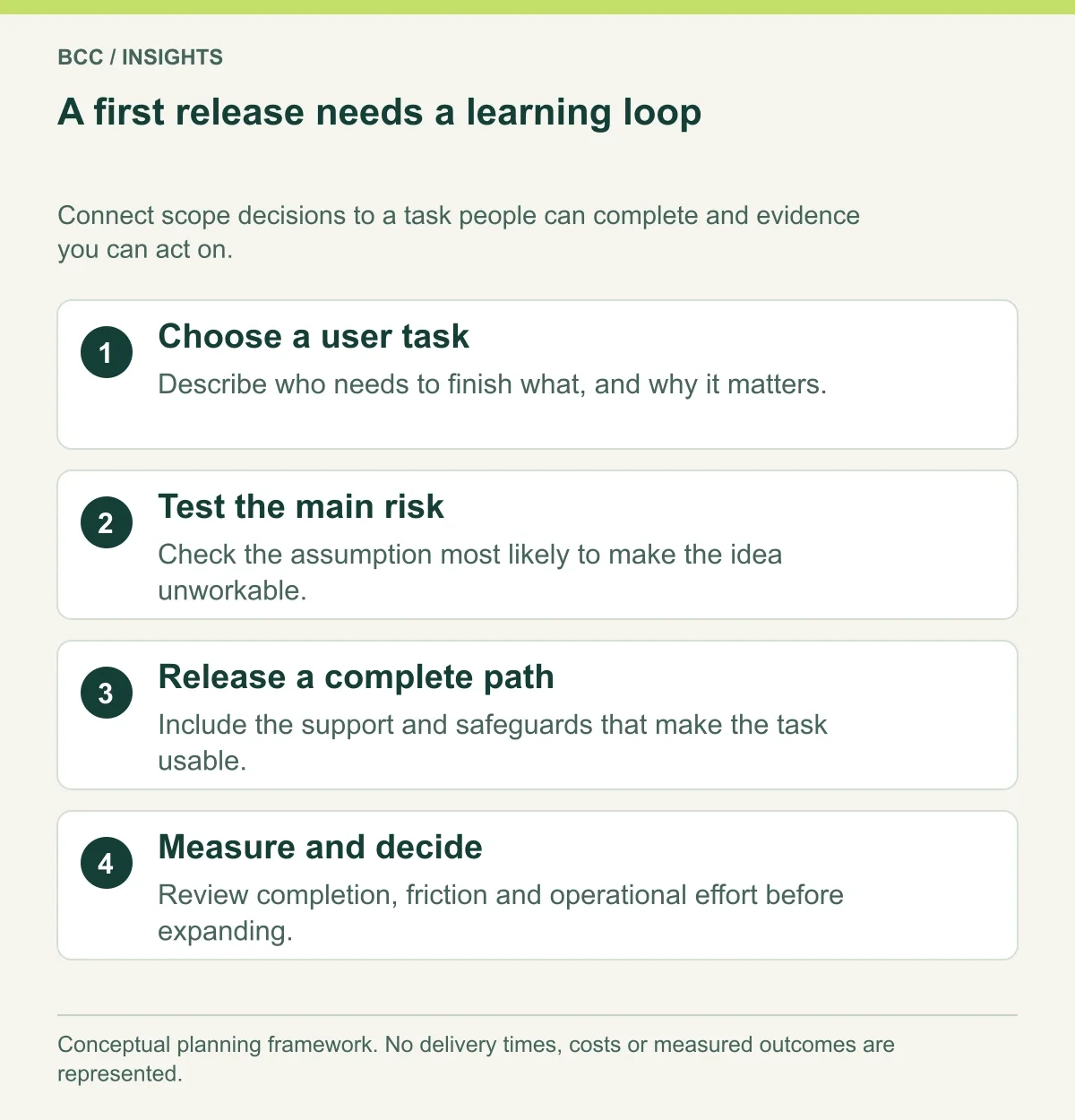
A first release needs a learning loop. Conceptual planning framework. No delivery times, costs or measured outcomes are represented.
Separate a learning prototype from a live service
A prototype can answer a narrow question with very little functionality. GOV.UK's alpha guidance describes testing risky assumptions and warns that prototype code is not production quality. A clickable screen may reveal whether people understand an approval step. It will not show whether permissions, data recovery or an external system connection work reliably.
A live release needs a usable path through the task and clear handling of failures. Identify which safeguards belong in that path: access permissions, appropriate data handling, accessible controls, error messages and support arrangements. Their depth depends on the service and its consequences. Deferring them without examining the impact can make early feedback difficult to trust.
Use UI and UX design to test the uncertain parts of the journey before committing to detailed implementation. Ask participants to attempt a task without coaching. Record where they hesitate or need workarounds, then distinguish a confusing interface from a missing business rule.
Work through a bounded example
Consider a hypothetical maintenance business testing an internal job allocation tool. The first release might cover receiving a request, assigning a technician and recording acceptance. Customer billing and complex route planning could remain in existing systems while the team tests this workflow. This is an illustrative scope choice, not a recommendation for every maintenance business.
Before release, the team would agree how to identify an unassigned job, correct a mistaken allocation and continue operating if the tool is unavailable. They could compare task completion and manual follow-up with the current process, while listening to coordinators and technicians. No improvement should be assumed in advance. If the main difficulty is poor incoming information, another screen may be less useful than changing the intake process.
Set a decision point before expanding
A pilot needs a review date and named decision maker. The GOV.UK beta model starts with limited access, feedback and iteration; the useful principle is controlled learning, rather than a fixed timetable. Review who completed the task, who struggled, which errors mattered and how much staff intervention was required.
Expand when the workflow is useful, supportable and ready for additional users.
Improve the current path when recurring friction prevents a fair test of the idea.
Revisit the assumption when users need a different outcome or the integration proves impractical.
Keep the evidence alongside the backlog so requests can be judged against the agreed outcome. Custom software development can then extend what the business has learned, with dependencies and ownership made explicit.
Bring your current workflow, the users involved and the decision you need to make to a discussion about MVP development. A useful starting brief explains what you want to learn and what a workable first release must let people do.
Sources
DTA: Digital Service Standard version 2.0 — 2024-07 PDF path; copyright 2023
GOV.UK: How the alpha phase works — Updated 2019-05-08; published 2016-08-04
GOV.UK: How the beta phase works — Updated 2021-02-19; published 2016-08-04
Editorial date: 19 August 2026, assigned for this retrospective Insights series. Prepared and sources checked on 30 October 2026. Updated 30 October 2026.